Technical product information from the process industry, developed within the NAMUR (User Association of Automation Technology in Process Industries), is to be represented in a structured manner in Asset Administration Shells in the future. To this end, IDTA (International Digital Twin Association) and ECLASS are working with industry representatives on a corresponding AAS submodel for NAMUR handover information.
At the heart of the collaboration is the question of how NAMUR's requirements for technical product descriptions can be represented in the Asset Administration Shell. An initial analysis shows that the relevant descriptions already contain numerous properties that can be represented using ECLASS Properties—for example, information on pump volume or pressure. Depending on the use case, around 20 to 40 ECLASS Properties may be relevant.
Use existing ECLASS properties and avoid duplicate development
The Joint Working Group is therefore examining how existing ECLASS content can be referenced in NAMUR handover information. This will allow established properties to be used and duplicate development to be avoided. If required content is still missing, the group will also clarify how Change Requests for ECLASS can be submitted and processed jointly.
For ECLASS, representatives of the Head Office and Siemens are participating in the initiative. NAMUR is represented, among others, by Gerd Schöbel of Bayer, who is a key driver of the initiative. Further ECLASS companies are to be involved in the collaboration.
Initial agreement has been reached to use ECLASS Properties for referencing properties and to create a suitable Aspect or adapt an existing Aspect for this purpose. This provides an important basis for representing NAMUR handover information consistently in AAS submodels and strengthening interoperability between different systems and applications.
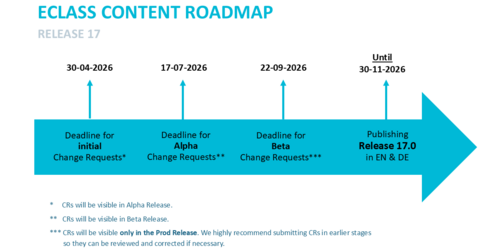
Given that the release phases for ECLASS Version 17.0 are already well advanced, a first submission for the alpha phase of ECLASS Release 18.0 in spring 2027 is currently considered realistic. The next steps will be coordinated within the Joint Working Group together with the participating industry partners.