1. Structuring via the N-Tier Hierarchy
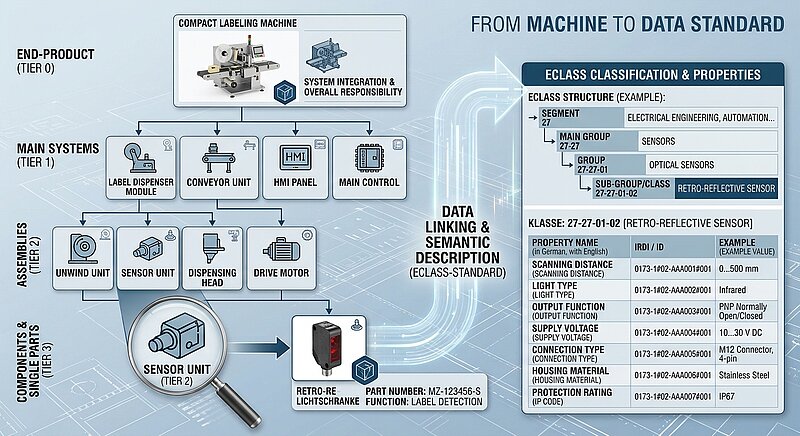
Before data can be harmonized, a machine, for example, must be divided hierarchically into logical levels. This taxonomy maps the multi-level bill of material (Multi-Level BOM):
- Tier 0 (End Product): The complete system, with a focus on overall function and system responsibility
- Tier 1 (Main Systems): Functional large modules such as a conveyor unit, dispenser module, or control system
- Tier 2 (Assemblies): Specific functional units, such as the sensor unit or dispenser head
- Tier 3 / Tier N (Components & Individual Parts): Discrete purchased and standard parts, such as optical sensors, motors, or connecting elements
2. Semantic Anchoring via ECLASS
Once the physical or functional position of each element in the system tree has been defined, a unique ECLASS classification is assigned to the nodes at the various levels.
- Unique Classification: Every component – such as the retro-reflective photoelectric sensor at Tier 3 – is unambiguously located within the international standard using the four-level ECLASS class key (e.g. 27-27-01-02)
- Standardized Property Set: Instead of proprietary free text, the component receives a standardized property set (e.g. sensing range, light type, output function, and supply voltage) with machine-readable IRDIs (International Registration Data Identifiers) and defined units of measurement
- Continuity Across All Levels: This principle can be applied not only to Tier 3: entire assemblies (Tier 2) or machine modules (Tier 1) can also be described in a standardized way using higher-level ECLASS classes
Value of the Approach: The combination of the N-Tier structure and ECLASS creates an interoperable data foundation. It enables seamless data exchange in engineering (CAD/PLM/ERP), accelerates procurement processes, and provides the semantic foundation for digital twins and Asset Administration Shells.