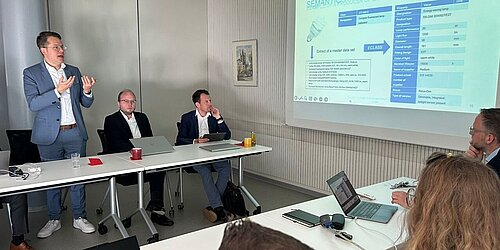
At the IDTA Kickstart Dataspaces Event, ECLASS joined representatives from industry and the digital sector to discuss current developments, requirements, and prospects related to dataspaces.
ECLASS was represented at the event by Thorsten Kroke and Carolin Prinz. The event provided a valuable opportunity to nurture existing relationships, gain new insights, and engage in direct dialogue with customers, partners, and other industry representatives.
During the discussions, it became clear that while Dataspaces are currently gaining significant attention, the underlying principle is not new. Structured data spaces and data pools have been used in various industries for many years to provide and exchange product information in a standardized manner.
A common semantic foundation is particularly important for the success of a dataspace. Only when data is described and understood in a uniform manner can a smooth exchange across company and industry boundaries succeed. This is precisely where ECLASS creates the basis for interoperability.
The following points were particularly focused on:
- Shared semantics as a prerequisite: In order to ensure that information is consistent and can be used across systems, dataspaces require a well-established semantic foundation.
- ECLASS als verbindender Standard: ECLASS as a unifying standard.
- Seamless integration with existing formats: ECLASS can be integrated with exchange and container formats, including BMEcat, AAS, OPC UA and GS1-CIN.
- The practical application depends on the specific use case.: Although centralized data rooms can be efficient for less complex products, decentralized, one-to-one exchange models are also relevant for highly customised products.
Once again, the event demonstrated that semantic standards are a key factor in the success of high-performance, future-proof data spaces. ECLASS will continue to support this development actively and contribute its expertise to the dialogue with customers, partners and the industry.