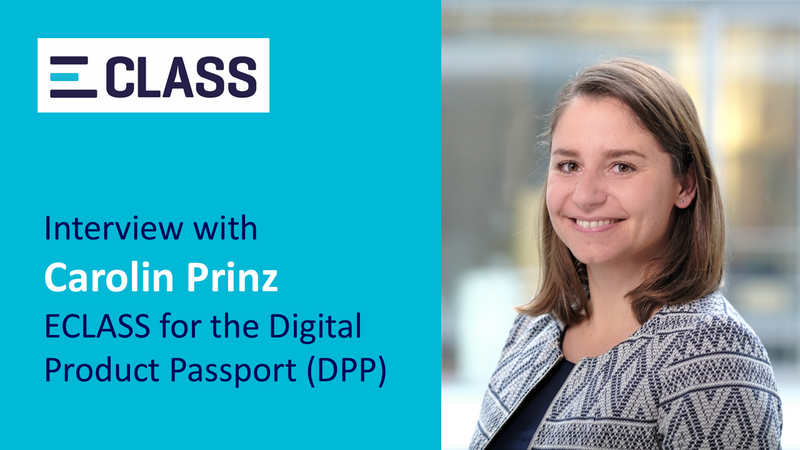
Question: Carolin, why is the Digital Product Passport so important in the industry right now?
Carolin: In the coming years, the Digital Product Passport will be a decisive turning point for sustainable value chains in Europe. It contains all the relevant information about a product, including manufacturing data, the materials used, and repair and disposal options. This data will be made available digitally and in a standardized format to all parties involved in the product's life cycle. Security concepts and role models are provided to ensure that the data is only displayed to authorized users.
Starting in 2027, the Battery Passport will be the first mandatory product passport, with other product groups gradually following. Companies should therefore start thinking now about how they can structure and make their data available throughout the entire product life cycle.
Question: What role does ECLASS play in this context?
Carolin: ECLASS is an internationally recognized classification standard and an established solution for standardized product data. With 48,000 classes and 23,000 properties, it enables precise, unambiguous and cross-industry product descriptions, forming the ideal basis for the Digital Product Passport.
A recent study by the German Economic Institute (IW) explicitly recommends using ECLASS as semantics for setting up a DPP. This confirmes that we are technologically and structurally in line with the requirements of the regulation.
Question: In what ways does ECLASS specifically support the technical implementation of a Digital Product Passport?
Carolin: ECLASS primarily uses the DPP4.0 approach to implement a Digital Product Passport via the Asset Administration Shell (AAS). This is a standardized digital container for product data throughout the entire life cycle.
This container is filled with ECLASS structural elements. The DPP consists of three main components:
Product identification: This information can be described using the AAS Submodel 'Nameplate/Type Plate'.
Product description: Application classes from the classification can be used to create a product-specific description.
Ecological information: Templates are available, for example, for Environmental Footprints, General Battery and Manufacturer Information, and Circularity and Resource Efficiency.
ECLASS also supports a variety of other data exchange formats, including BMEcat, OPC UA and GS1XML. This provides a variety of options for data exchange.
Question: What are, in your opinion, the strongest arguments for ECLASS in the context of the DPP?
Carolin: ECLASS is an established standard that offers a high degree of interoperability thanks to its wide range of usable exchange formats. It is available in 31 languages and used by thousands of companies worldwide. It is also manufacturer-independent and cross-industry, harmonizing different industry languages.
Identifiers such as GTIN or DUNS can also be easily mapped using ECLASS.
ECLASS plays an active role in the international and German standardization community, helping to develop standards while also complying with them. ECLASS therefore provides a robust and future-proof basis for consistently and unambiguously providing product data in a DPP-ready manner.
Question: Why should companies act now?
Carolin: The regulatory framework for providing the DPP has largely been defined, enabling ECLASS to offer an efficient, standards-compliant solution.
When customers use the ECLASS solution, they can focus their resources on obtaining data from the value chain. This is not about the height, width and weight of the product. It is about data from a product's value chain that can be used to calculate its carbon footprint, for example.
A cleanly structured data management system also enables significant internal efficiency gains, regardless of the DPP. So, it pays off twice.
Learn more: eclass.eu/en/application/digital-product-passport-dpp